Spindle Repair: Professional Service and Diagnosis
In the CNC machining ecosystem, few failures generate as much panic and operational costs as a spindle failure. It's not just a motor; it’s the heart of your machining center.
When precision fails or noise increases, production comes to a halt. In this technical guide, we break down the process of spindle repair, from vibration diagnosis to the final run-in, so you understand how we bring this critical component back to life with original factory specifications.
What is a spindle and why is it the heart of your machine?
A spindle is not simply a rotating motor. It is a complex integration of mechatronics that combines an electric stator, a high-precision rotating shaft, tool holding systems, and ultra-precision bearings, all housed in a compact casing.
Unlike a conventional motor, the spindle must withstand immense axial and radial loads while maintaining runout tolerances of less than a few microns. It is directly responsible for the surface quality of your parts and the efficiency of chip removal.
Understanding its complexity is the first step in appreciating why professional repair, and not just a "quick fix," is vital to maintaining your shop's profitability.
Symptoms that indicate your spindle needs immediate repair
Catasrophic failure rarely occurs without warning. Your machine "speaks" to you through physical signals. Ignoring these symptoms often turns a maintenance repair (bearing change) into a major rebuild (shaft grinding or rewinding).
Unusual noises and vibrations
Silence equals precision. If you hear a sharp buzzing, a metallic "grunting" when changing RPMs, or notice an increase in vibrations mm/s (monitored by the machine's accelerometer or an external analysis tool), it's a red alert.
Likely cause: wear on the bearing races or imbalance in the rotating shaft.
Excessive heating
Spindles operate at controlled temperatures. If you detect that the casing is hot to the touch or that the liquid cooling system fails to lower the temperature, the risk of seizure is imminent.
Likely cause: failure in the cooling circuit, blockage, or excessive friction due to incorrect bearing preload.
Loss of precision or poor surface finish
When parts come out with vibration marks (chatter), dimensions are not maintained, or the mirror finish disappears, the problem is usually mechanical.
Likely cause: axial or radial play in the assembly, or wear on the ISO / HSK taper that prevents a perfect fitting of the tool holder.
The spindle repair process step by step
The difference between a standard repair and a high-level restoration lies in the protocol. Our process follows a rigorous methodology to ensure the E-E-A-T (experience and technique) that your machinery demands.
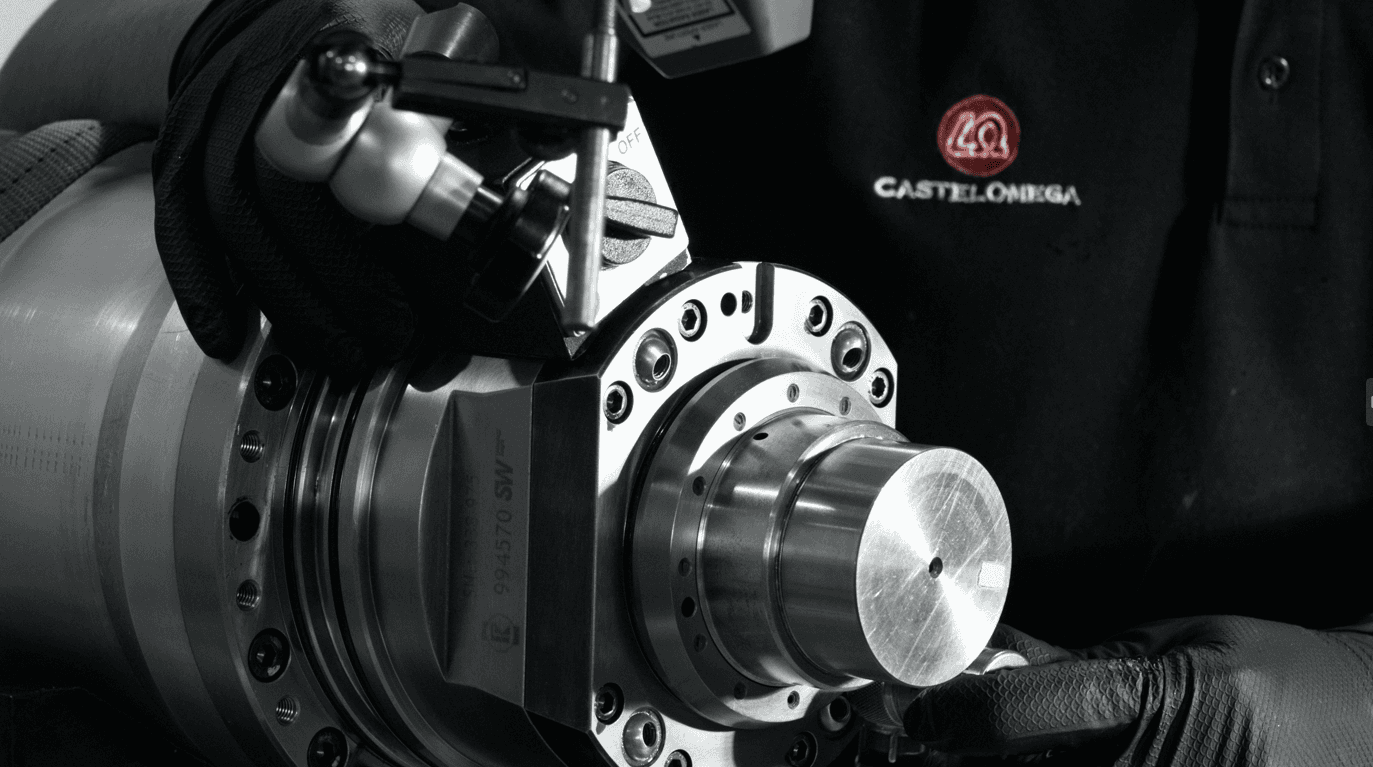
1. Disassembly and failure analysis
We do not use brute force. We use specific hydraulic and thermal extractors to disassemble the head without damaging the housings. In this phase:
We measure the initial runout.
We verify the clamping force of the clamping system.
We check the condition of the sensors and the encoder.
2. Cleaning and grinding of components
All pieces are cleaned in ultrasonic baths. If we detect wear on the bearing housing or on the spindle's nose, we proceed to grind the tapers (HSK, BT, ISO) and the bearing seats using hard chrome and grinding to original size (tolerance H5/h5).
3. Replacement of high-precision bearings
This is the critical point. We do not install standard bearings. We exclusively use precision bearings (class P4 or P2) with angular contact, often with ceramic balls (hybrids) to support high RPM.
Technical key: the adjustment of the preload (rigid or elastic) is done in a "clean room" to avoid any dust contamination.
4. Rewinding of stator and review of electronics
If the failure was electrical, we perform the stator rewinding using high thermal capacity resins and class H insulation. We also adjust and calibrate the encoder and position sensors to ensure that your machine's frequency converter correctly reads speed and angular position.
5. Dynamic balancing and running on a test bench
A spindle does not leave our facilities without being tested.
Dynamic balancing: we perform fine balancing according to ISO 1940/1, reaching quality grades of G2.5 or G1, eliminating any residual vibration.
Run-in: we subject the spindle to a progressive run-in cycle for several hours. This is essential to properly distribute grease in the bearings and stabilize the operating temperature before the spindle touches a real part.
Repair or replace? Cost-effectiveness analysis
For purchasing and maintenance managers, this is the key decision. Is it worth repairing?
Factor | Professional Repair | Purchase of new spindle (OEM) |
Cost | 40% - 60% of the price of a new one. | 100% of the list price. |
Delivery time | Generally 3-10 working days (depending on damage). | Weeks or months (if no stock at the factory). |
Performance | Equal to the original (same quality spare parts used). | Factory standard. |
Warranty | Yes (normally 6-12 months on the repair). | Yes (manufacturer's warranty). |
Sustainability | High (circular economy, reuse of housings and shafts). | Low (complete new manufacture). |
Verdict: unless the spindle has suffered a catastrophic accident (shaft breakage or irrecoverable casing), repair is the smartest option both financially and operationally.
Preventive maintenance: how to extend the life of your spindle
The best industrial corrective maintenance is the one that does not have to be done. Here are three expert tips to maximize the lifespan of your machining head.
Importance of lubrication and sealing air
Most premature bearing failures are caused by the ingress of coolant or dirt. Ensure that the sealing air is always active, dry, and perfectly filtered. Positive air pressure prevents contaminants from entering the bearing labyrinth.
The cooling system
Monitor the chiller. A dirty or degraded coolant loses thermal transfer capacity, overheating the stator and expanding mechanical components, which affects the final precision.
Warm-up cycles
Never go from 0 to 15,000 RPM cold. Implement a gentle warm-up program at the start of each day (e.g., 10 minutes at low speeds) to allow the grease in the bearings to reach its operational viscosity and thermal expansions to stabilize.
Types of spindles we repair
Our experience covers the diversity of the CNC market:
Milling spindles: high speed and constant torque.
Grinding spindles: ultra-precision and high RPM.
Lathe spindles: high load and robustness.
Common brands: HSD, Franz Kessler, Gamfior, Omlat, Siemens, Fanuc, among others.
Frequently Asked Questions about spindle repair
Do you provide a vibration report after repairs?
Yes. Each repair includes a detailed technical report with initial and final vibration values, as well as the balancing certificate and encoder check.
Is the tool clamping force checked?
Absolutely. We verify the clamping force of the spring pack or hydraulic system to ensure that the tool does not come loose under cutting load.
Can you repair the taper if it is marked?
Yes, through metallizing and grinding techniques we restore the exact geometry of the taper (ISO, HSK, BT) to ensure the correct taper contact and avoid runout.
Conclusion and request for a quote
A faulty spindle is a bottleneck in your production. Don’t let technical uncertainty paralyze your shop.
Our spindle repair service combines mechanical craftsmanship with the most advanced diagnostic technology to return a component ready for machining with micrometer precision.
Is your machine vibrating or making noise? Don’t wait until it seizes.
[Request your free diagnosis and no-obligation quote here]